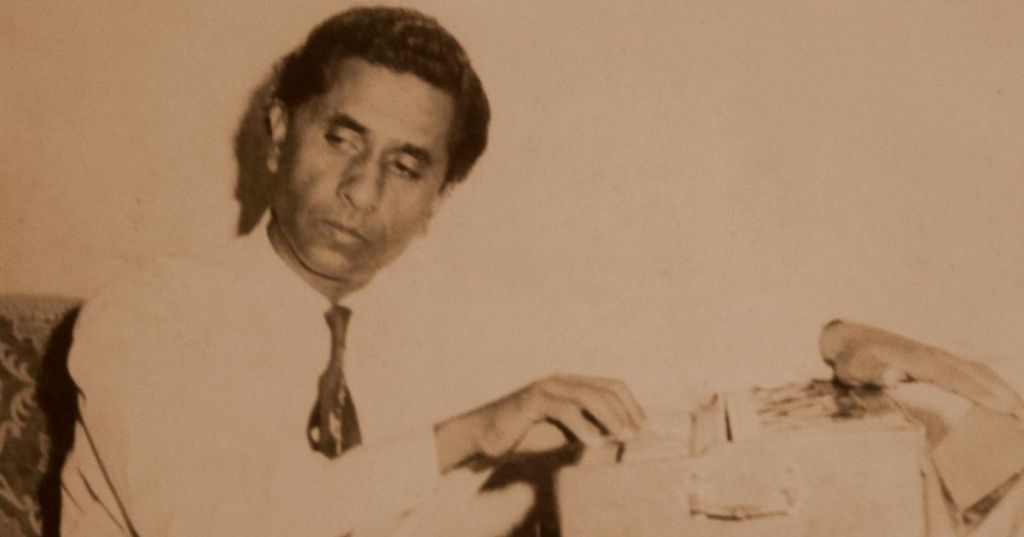
15th June 1917 to 21st July 1995
He scored music for just around 100 songs in 18 films , yet he is still talked about as one of the most original music composers of Hindi film music.
He rubbed many film producers, actors , directors in the wrong way and as a result some of his film’s songs were not even released in gramophone records! Yet his songs, thanks to the Internet, are still talked about and there are many articles and videos made on them.
Singers and musicians had the jitters during his recordings as he was the ultimate perfectionist; yet the great singer Lata Mangeshkar , who was also once chided by him in one of his recordings , consider him to be a genius composer. Veteran music director Anil Biswas called him as the most original music director in Hindi film music as he believed all others, including himself, were at some time or the other , influenced by other music. Sajjad’s every note, he said , was original.
That , in a nutshell , is Sajjad Husain. Sometimes we may think if such a great mind would have been less stubborn , we, the music lovers, could have enjoyed thousands of his songs rather than the meagre hundred odd songs he has left behind. But who are we to comment or judge? Most of the extremely talented minds always have that very strong individuality which we should respect. It is unfortunate and a loss for the Hindi film music world that it could not understand, appreciate, and recognize his music the way it should have.
I will not be going in detail about the various controversies he got into due to his mercurial temperament and would instead try writing about his great music. If the reader searches in the internet and YouTube, there are umpteen stories of them. I feel it shifts the topic more towards his mercurial temper and as a result his music gets less talked about. I can only attempt to translate my passion in listening to his songs as a layman and write about them as to how I perceive them. I also wish one day someone having a deeper knowledge about music would try to bring more rigor to the analysis of his songs.
Sajjad Husain was born on 15th June 1917 to Mohammad Amir, the last of 9 siblings , in a place called Sitamau , then a princely state in Central India ( modern day Madhya Pradesh). His father was a tailor in the durbar of local king Raja Ram Singh . For grand occasions , his father used to stitch clothes for the king and the young Sajjad used to accompany him to the durbar. Those days the royal durbar was full of musicians, dancers and he slowly got interested in music. Among the siblings , Sajjad was the only one interested in music. Gradually he learnt to play the sitar and once he observed the mandolin being played at the local Tehsildar’s place. He wanted to play that instrument , but was denied access to it. He made his own mandolin and mastered the art of playing that! It was only much later that he got as a gift from a Jewish musician , Rahim Solomon, a proper mandolin. His father encouraged his interest in music and gradually the young Sajjad mastered many instruments like piano, harmonium , violin, flute, Jal tarang , veena, vichitra veena, clarinet, Spanish guitar, and Hawaiian guitar .
Like all others who wanted to make their career in films, he shifted to Bombay ( present day Mumbai) in the year 1937. After trying a brief career as a member of orchestra in Minerva Movietone and Wadia Movietone, he felt that was not what he wanted. After another brief stint at All India Radio, his inner urge to be an independent music composer drove him to music directors Mir Saheb and Rafiq Ghaznavi and reluctantly became their assistant. Being proficient with many instruments, he also took up a contract job with Shaukat Hussain Rizvi , who later married noted actor-singer Noorjahan. In the 40’s he once again assisted Ali Baksh , father of famous actor Meena Kumari , himself a music director and also the music director Hanuman Prasad. The latter gave him opportunity to score few songs for the film Galee ( 1944). Shaukat Hussain Rizvi gave him the first break as an independent composer for the 1944 film Dost. As fate would have had it , he had a major dispute with Rizvi when the latter credited his wife Noorjahan for the success of its music. Many such issues kept happening -as I had assured in the beginning , I will not go into those negative aspects of his stubbornness. Any article about him in the Internet will carry loads of them. Lata , in one of her interviews , said that many of those stories were exaggerated and spread to demean him.
He comes out as a perfectionist to the extreme . He made Talat Mehmood go through 17 takes for the famous song “ Yeh Hawa Yeh Raat Yeh Chandini “ . He never had assistants and used to conduct the entire orchestration himself even to the extent of writing down the “ bol” for the tabla player! Like many such genius who had that intense passion for perfection , any interference or mistakes would bring out the temper in him.
As a result , in three decades of musical career in Hindi films , he composed only around 100 songs in 18 films ( including one Sinhalese film Daiva Yogaya that became a hit mainly for its music!) , but what compositions were those! He created absolutely stunning tunes, unusual rhythm patterns, and unexpected twists and turns in the song . No doubt many stalwarts in music , like Anil Biswas, Lata Mangeshkar, C Ramachandra and even his close competitor Naushad , considered him as one of the best composers ever to have graced the Hindi film music world.
Like how his music was complex and un-structured, I am not going in for the usual chronological listing of his songs and would rather take his major works first and then go in a random way about his other songs, many of which have been forgotten but are true gems. Among his works, Rustom Sohrab, Sangdil and Saiyyan may be considered as major as most of the songs from these 3 films are true gems. Even if we consider the other films as lesser works, once we listen to the songs many times, we can appreciate those songs better . It is purely my opinion that the complex , difficult-to-sing compositions might have been both a gift and a curse ! Curse, because the very nature of those songs could have made them so difficult to be reproduced by other singers . In how many singing contests have we seen a Sajjad’s composition being attempted?!
I am presenting the major films Rustom Sohrab, Sangdil & Saiyyan first and then , in not any particular order , his other songs. Under each film , the year of release is mentioned and then the song/singer(s)/lyricist are given.
Rustom Sohrab-1963
- Ae Dilruba- Lata-Jan Nissar Akhtar
One may have to dedicate a separate article only for the songs of Rustom Sohrab, considered as Sajjad’s magnum opus. It was also his last major work, although there were two other films in the seventies -Mera Shikar in 1973 and Aakhri Sajda in 1977, the music of which were no doubt unique but they went completely un-noticed.
Ae Dilruba Nazren Mila could be one of the toughest songs ever composed and who else to make it immortal than the great Lata ! Each and every note of this song, though based on Arabic style , is so unique and intricate. I think this could be the shortest lyrics ever written for a film song, but how wonderfully Sajjad created a superb prelude and a postlude that has only Lata’s vocals performing a virtual gymnastics!
Ai dilruba nazre mila
Kuchh to mile gam ka sila
Ai Dilruba…….
Ashkon ka ek dariya baha
Pyasa tha dil pyasa raha
Nazre mila, nazre mila
Rehne na de koi gila
Ai Dilruba, ai Dilruba……
That is all!-five lines in the song! Rest is sheer magic woven by Sajjad with a scintillating tune , orchestration and not to forget , one of the best renditions by Lata. I do not think anyone can visualize such a song except Sajjad. The prelude has violins, sarangi and santoor playing one after the other in sequence. Throughout the song the piano keeps playing at the background subtly , enhancing the melody. Percussion arrangement was always unique in Sajjad’s music and you can observe that in almost all his songs.
2. Ye Kaisi Ajab Daastan- Suraiya-Qamar Jalalabadi
The most talented singer of yesteryears , Suraiya bid farewell to her singing & acting career with this swan song. What a grand way to end her career! Sajjad always employed very catchy rhythm patterns and this is one more classic example. The interlude starts off with violins slowly building up the tempo , reach a peak and then stop abruptly , only to give way to that fabulous piano taking over. Piano notes keep coming in between the lines like a wave.
3. Mazandaran Mazandaran- Rustom Sohrab-1963-Talat Mehmood- Jan Nissar Akhtar
I have not seen the film Rustom Sohrab, but understand it is based on the tragedy of Rostam and Sohrab ( father and son who tragically fight each other not knowing their relationship ) that forms part of the 10th-century Persian epic Shahnameh by the Persian poet Ferdowsi. This song is about a singer who praises the land from where comes , Mazandaran ( there is a province in Iran by that name) . Personally I consider this song as one of the best by Sajjad & Talat although Yeh Hawa Yeh Raat Yeh Chandini is more popular. I like the unusual rhythm pattern and the way Sajjad blends the violin, flute and piano , that follows the singer throughout. The interlude piece is sheer bliss-the strings of violin initially come rushing like waves, only to fade away gradually! One can only imagine if such songs were recorded with today’s superior technology , what could have been the result!!
4. Phir Tumhari Yaad Aayee- Mohammed Rafi, Manna Dey, Sadat Khan & chorus- Qamar Jalalabadi
When Sajjad composes a qawwali , it is bound to be different from others. He has used the three singers Rafi, Manna Dey and Sadat Khan so well . The song starts off with only Rafi’s voice deceptively as if it was a solo song. Sajjad builds it into a qawwali gradually . Note the unusual start “ aaaaa” hummed by Rafi and abruptly switching over to Phir Tumahari Yaad aayee line. Each antara has an alaap that keep oscillating , ending with a flourish accompanied by an early form of synthesizer ( I read somewhere it is the Univox) . This is no doubt one of the most popular songs of Sajjad .
Sangdil-1952
5. Yeh hawa Yeh Raat Yeh Chandini-Talat Mehmood-Rajendra Krishan
Sangdil and Rustom Sohrab-music of these two films are just enough to keep Sajjad’s memory alive for thousand years. Although I am personally a fan of many other legendary music composers, but the songs from these two films are simply out of the world and when I listen to them , I feel Sajjad was way ahead of his contemporaries.
Yeh hawa yeh raat yeh chaandini is one of the most popular songs of Sajjad. The way he had used the sitar and sarangi at the beginning and in the interludes is the work of a genius. Sajjad castigated veteran composer Madan Mohan for taking this tune for his “ Tujhe Kya Sunaoon Mein Dilruba” with the comment “Aaj kal humare gaane kya, hamare parchhaiyan bhi ghoomne lagi”! Madan Mohan had to pacify him with an apology that he took inspiration not from any ordinary music composer but from the great Sajjad Husain!
6. Dil Mein Sama Gaye Sajan-Talat & Lata- Rajendra Krishan
What a great romantic melody! If there is love and romance in this world, this song will be there to define it. Rajendra Krishan’s starting lines, composed at such high octaves and rendered so effortlessly by Lata set the stage for a grand aural treat that you can hear :
Aaj preet ne tod di, bandhan ki deewar
Haar maanke preet se chala gaya sansaar
Sajjad , with those typical extended phrases “ samaaaa gaye sajan” , masteeee bharee hawa chali that continue throughout the song , creates another timeless classic.
7. Darshan Pyasi Aayi Dasi”-Geeta Dutt- Rajendra Krishan
It is a popular belief that Sajjad’s music had lot of Arabian influence . No doubt that is true, but listen to this superb bhajan composed by him that is totally different It is unpardonable that no radio /TV program ever airs this song. Geeta Dutt could render such bhajans with so much of emotion and Sajjad had rightly chosen her for this song. The highlight of this song is the Jal Tarang , played by Ustad Alauddin Khan . Sajjad has used the jal tarang throughout the song to sound like temple bells. The beauty of that jal tarang is that it runs almost in sync with the tune at times and as a counter melody in others. The tune is so mesmerizing that one would like to listen to it multiple times to get oneself immersed into the song.
8. Kahan Ho Kahan Mere- Talat – Rajendra Krishan
I am not an authority on music , but I understand this could be one of the earliest use of piano as a percussion instrument. If you listen keenly it provides rhythm and at the same time accompanies the singer, goes into a counter melody also at certain places. I really wish I knew something about the nuances of music to write about such intricate compositions. Mind boggling composition! The songs ends with an unusual high note ! Talat Mehmood was lucky to have three of his best songs composed by Sajjad.
9. Woh To Chale Gaye Ae Dil- Lata- Rajendra Krishan
Rajendra Krishan was a versatile lyricist and gave evergreen songs with many music directors and his work with Sajjad in the film Sangdil is one of his best.
Who Toh Chale Gaye Ae Dil
Yaad Se Unki Pyaar Kar
Jeene Mein Kya Maza Raha
Maut Ka Intezaar Kar!
In many other films of Sajjad , there were multiple lyricists but all the songs of Sangdil were written by Rajendra Krishan.
Saiyyan-1951
10. Us Paar Is Deewar Ke Jo Rehte Hain- Rafi-D.N Madhok
For a change , this is a lighter tune from Sajjad -a lilting sweet melody and once again , not heard in the popular stream. Picturized on Sajjan who is known for his character roles , the way Sajjan has acted out this song on screen is a delight to watch.
11. Kali Kali Raat Re Dil Bade Sataye- Lata- D.N Madhok
Sajjad once commented “ give me Lata and I can keep on churning out magical tunes ”. Lata has said that Sajjad was one of the most misunderstood genius of Hindi film music; in early days the only composer whose recordings she used to be jittery was Sajjad for the perfection that he demanded from his singers and instrumentalists. Can you believe that there is no gramophone record made for this film. I saw a video wherein the noted music director Hridayanath Mangeshkar talks about how , those days, the gramophone company manger used to decide whether song was “ fit” to be recorded on gramophone or not! No wonder Sajjad never bothered about those in the film industry who ‘dictated’ terms to him. In this song , right from the mukhda to the antara , the orchestration in the background all are top class, yet I am sure majority of us would not have heard this song often. A timeless masterpiece , rendered flawlessly by the nightingale when she was just 22 years old!
12. Hawa Mein Dil Dole- Lata- Rajendra Krishan
Sajjad’s orchestration was always strong with string instruments, piano etc. as he himself was a master in playing them. This one has a beautiful flute playing through out , coupled with a catchy rhythm and a superb chorus supporting Lata’s young voice. Again, note the way the antara starts off in an unconventional manner.
Khel -1950
13. Woh Aaayenge- -Shamshad Begum-Zia Sarhadi
Sometimes I wonder how such songs lie hidden for years , even decades! I have never heard this song till I started working on this blog. Even some of the earlier blogs/ YouTube videos on Sajjad do not mention this song. After I heard this song, I might have listened to this at least 50 times! What a power-packed rendition by the veteran Shamshad Begum! Only she can pull off such songs. One must listen to this song minimum thrice-first time for the tune, then for Shamshad’s singing and then third time for the unique structuring of the lyrics. Zia Sarhadi was a lyricist, screen play writer and has come out with unconventional lyrics.
14. Apni mehfil mein phir ek baar chala aane de- GM Durrani-Jan Nissar Akhtar
A unique song that has no percussion instrument except for the interludes. Very softly rendered by one of the well-known singers of the vintage era, G. M Durrani.
15. Jate Ho To Jao Hum Bhi Yahan- 1950-Lata-Sagar Nizami
One more example of how the complexity in his melodies could have been one of the reasons why they were more appreciated by connoisseurs of music and remained ignored by the masses. The notes with which this songs starts is testimony to this.
16. Bhool Ja Ae Dil Mohobbat Ka- 1950-Lata-Shams Azimabadi
One of the most popular songs from this film, this is an absolute stunner. The antara has Lata stretching certain words unexpectedly and that is the specialty of Sajjad. In his compositions , the interludes were relatively very short; the intricate twists and turns in the antara make up for the short interludes!
Dost-1944
17. Badnaam Mohobbat Kaun Kare-Noorjahan-Shams Lakhnavi
Sajjad’s first major work as an independent composer was in this film. Initially , when I heard this song it sounded a bit odd -especially the way Noorjahan the word stresses on the word “ Badnaam!” But once you listen to this repeatedly , then can appreciate how different his compositions were at the very beginning of his career. A subtle percussion, strings & clarinet following with the singer and a “blink and you miss” piece of jal tarang in the second interlude.
18. Koi Prem Ka Deke Sandesa- Noorjahan-Shams Lakhnavi
In contrast to the peppy ‘Badnam Mohobbat’ an eighteen-year-old Noorjahan renders a song full of pathos in such a mature way! Sajjad uses a slow waltz rhythm for a sad song. A bass flute, strings, and a subtle tabla beat-with bare minimum orchestration Sajjad weaves a magic!
1857( film name)- 1946
19. Teri Nazar Mein Rahoon Meri Nazar Mein Tu-Surendra & Suraiya-Mohan Singh
Most of Sajjad’s compositions , have an intricate tune , more intricate alaap in between, unusual rhythm patterns , unexpected phrases that are either longer than what one would anticipate or equally stunning abrupt , short phrases that one would not be expecting. I wish I knew some rudimentary knowledge on music to explain these aspects properly. Waltz seems to be one of his favorite rhythm , but he has used that in so manyvariants!! In this song , notice the way he has made both the singers extend the word “ hoon” like an elaborate humming.
Rooplekha -1949
20. Teer pe teer khaye jaa- Mohammad Rafi – Khumar Barabankvi
Rafi was slowly getting recognized by 1949 and this early song with Sajjad shows his great maturity in singing , at a young age of 25 years. Sajjad keeps the orchestration to the bare minimum level and lets the tune dominate. Note how the antara starts with just a recital and then slowly the tempo picks up.
Rukhsana-195521. Ye char din bahar ke – Kishore Kumar and Asha Bhosle, lyrics Shakeel Badayuni
Who can ever imagine Kishore Kumar, more famous for his peppy , fast songs , coming out with such a superb soulful number. Note the over-lapping alaap in both the antara with Kishore and Asha making a complex composition sound so easy. No wonder Sajjad was considered a tough task master!
Daiwayogaya-1959 -Sinhalese Film
22. Adarayai Karunawai – Rukmani Devi –
Although I do not have any idea about the Sinhalese language , I am adding one last song that made Sajjad famous in neighboring Sri Lanka. Music transcends language and even if one does not understand the lyrics, the music of Sajjad conveys the pathos inherent in the song.
Acknowledgement & Disclaimer
I sincerely thank the publishers of following Internet sources for the information that I could gather for this article:
- You Tube
- Wikipedia
- Songsofyore blogsite on music
- All those who uploaded the forgotten gems of Sajjad in YouTube
Acknowledgements and Disclaimer:
The songs mentioned are from the popular, public domain and have been mentioned and embedded here only for the listening pleasure of the music lovers. This blog does not claim any copyright over them, which rests with the respective owners of the rights.
 Music Unrestricted