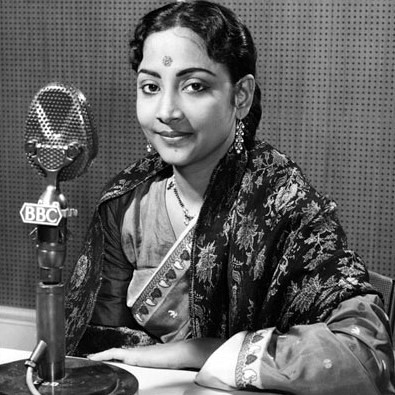
23rd November 1930-20th July 1972
A voice that can convey varied emotions like an intense pathos , the ebullience of a girl in love, a devotional fervour , the carefree tease of a cabaret dancer etc. It is really difficult to describe the voice of Geeta Dutt (born Geeta Ghosh Roy Chowdhuri). When we observe the different female playback singers of Hindi film music, we have sweet-as-nectar Lata Mangeshkar, Suman Kalyanpur and at the other end , powerful , ringing metallic voices like Shamshad Begum, Noorjahan . Somewhere in-between Geeta could find a niche for herself , with a combination of a commanding voice that can also sound so melodious. So we could hear the pain in her Waqt Ne Kiya Kya Haseen Sitam, the peppy Mera Naam Chin Chin Chu or Babuji Dheere Chalna and also a mellifluous Koi Chupke Se Aake Sapne that she sang in her last film before fate snatched her away cruelly at the young age of 42.
Like it happens purely by chance, the time I am publishing this blog is close to the anniversary of Geeta Dutt that falls on 20th July and just few days back, on 9th July , it was the birth centenary of her husband and noted film producer-writer-actor-director Guru Dutt.
Like the intense films that her husband used to make , their personal lives were also entangled in many twists and turns. Both were great artists and unfortunately except for few years , their married life was not a happy one with Guru Dutt very sadly passing away in 1964 at the age of 39 and Geeta Dutt followed eight years later , when she was just about to complete 42 years. There are many articles in the Internet about their personal lives and it must be known to many also and hence I will not elaborate further on that and instead focus more on her fabulous songs.
Geeta was one of 10 children born to a wealthy zamindar family in a Faridpur district in East Bengal, that is now Bangladesh. Her family moved to Calcutta and Assam in the early 1940s, leaving behind their land and properties. In 1942, her parents moved to an apartment in Bombay. Geeta was twelve and continued her schooling at the Bengali High School.
During her days in East Bengal , she trained as a singer under her music teacher, Hirendranath Nandy before her family settled in Bombay. The composer K. Hanuman Prasad heard her singing in her house when she was in Bombay and was impressed by her voice . He gave her the first opportunity to sing in the mythological film Bhakta Prahlad. She was given two lines to sing for two songs. Though she sang for few movies subsequently , it was the 1947 film Do Bhai that gave her the much-needed breakthrough, with the popular song “Mera Sundar Sapna Beet Gaya” scored by S. D. Burman becoming a hit. There was no turning back for her and soon she started singing for more than a dozen films in the next two years. Despite one more legend, Lata Mangeshkar storming the music industry in 1949, with Barsaat , Mahal etc , Geeta had her own place and was well established as a leading female playback singer.
In 1951, the film Baazi turned the career of many artists apart from that of Geeta Dutt- S D Burman the composer , Guru Dutt for whom this was his debut as a director and also for Sahir Ludhianvi, the great lyricist. Her songs in the Hindi film Baazi, with music composed by S. D. Burman, were highly well-received with the song “Tadbeer se bigdi hui taqdeer bana le” being an eternal favourite. It was also during the song recording for this film that she met and fell in love with Guru Dutt .
Apart from Hindi she was also well received in Gujarati films despite not knowing the language, and of course in her native Bengali films. After their marriage, she sang in all of Guru Dutt’s subsequent films with songs from films like Mr. & Mrs. ’55, C.I.D., Pyaasa, Kaagaz Ke Phool, and Sahib Bibi Aur Ghulam being etched in our memory.
There was a time when Guru Dutt did not want her to continue her singing career and coupled with the personal turmoil she faced in her married life with Guru Dutt , she turned to alcohol and slowly her career started declining in the late-1950s. The music composers who gave her immortal songs , S D Burman and O P Nayyar drifted towards Lata Mangeshkar and Asha Bhonsle respectively. Unfortunately she could not even take the opportunity of the spat between Burman da and Lata for few years as he had started preferring Asha .
Fate brought in a severe blow to her when Guru Dutt’s passed away in 1964 ( was it suicide or an accidental overdose of sleeping pills with heavy drinking-it is still debated). She performed even more infrequently in films. After a long hiatus , for composer Kanu Roy, she recorded three superb songs for Basu Bhattacharya’s film Anubhav in 1971. Just like a lamp that burns the brightest just before fading out , these songs show how she was still able to render classic masterpieces.
In all , over a 25-year career, Geeta Dutt recorded over 1,400 songs in various languages , mostly in Hindi, Bengali and Gujarati, few in languages like Marathi, Maithili, Bhojpuri, Punjabi, and Nepali. With Guru Dutt, Geeta Dutt had two sons, Tarun (1954-1985), Arun (1956-2014) and a daughter, Nina (b. 1962). She died on 20 July 1972 due to liver cirrhosis aged 41, in Mumbai, Maharashtra.
Geeta Dutt had a voice that can convey various emotions with an intensity that was unique to her. Compared to her other illustrious contemporaries, she was relatively less trained in the techniques of singing , but could compensate that with the intensity and emotions she brought out in her singing.
I have tried my best to list out 25 songs -some very popular and few that are relatively rare. Listing is in chronological order of the year of the film, with song-film-year-music director-lyricist and any co-singer mentioned in that order. The usual disclaimer -these are purely my personal favourites and it is very difficult to capture that huge variety of songs she had rendered in a short article.
<Some of the links to the songs embedded here do not play from the video version of the songs due to restrictions in Youtube and in those cases I have provided only the audio version links>
- Mera Sundar Sapna Beet Gaya -Do Bhai-1947-S D Burman-Raja Mehdi Ali Khan
Geeta Dutt would have been just 17 years old when this song was recorded-what a maturity in her voice and the emotions she had conveyed became one of her greatest strengths.
2. Ghunghat Ke Pat Khol re tohe piya-Jogan-1950- Bulo C Rani-Meera Bai
This Meera bhajan composed so nicely by one the legends of the vintage era of Hindi film music, Bulo C Rani ( for a long time I was under the wrong impression this was a female music director but it was actually a male Bulo Chandiram Ramchandani!). The devotional genre was one more feather in her cap for Geeta Dutt.
3. Tadbir Se Bigdi Hui Taqdeer-Baazi-1951-S D Burman-Sahir Ludhianvi
It was a unique strength of Geeta Dutt that she could render a song full of pathos or a devotional one with as much skill as the fun-filled , peppy numbers like this one. It is said that people used to watch the movie Baazi only for this song, repeatedly! That ‘hey hey heyyyyy’ by her makes this song immortal.
4. Suno gajar kya gaaye-Baazi-1951- S D Burman-Sahir Ludhianvi
Burman da composed this with a grand orchestration that was rare in those days. A fast paced, combination of Spanish gypsy and Arabian music styles , Burman da truly excelled in this composition. The way Geeta Dutt sings the second antara-Husn bhi faani aur Ishq bhi faani hai marks her distinct style.
5. Yeh kaun aaya Baazi-1951- S D Burman-Sahir Ludhianvi
The film Baazi had both Geeta Bali and Kalpana Kartik and note how Geeta Dutt renders this song , picturized on Kalpana in a different tone when compared to those she sang for Geeta Bali.
6. Jai Jagadish Hare -Anand Math-1952-Hemant Kumar- Composed By Sanskrit Poet Jayadeva Circa 1200 AD-With Hemant Kumar
One of the masterpieces from Hemant da, Anand Math was his debut film in Hindi as a composer. This could be one of the rarest songs of HFM in which a Sanskrit shloka was taken from the 13th century work ‘Geeta Govinda’, by a Sanskrit poet Jayadeva . It is amazing to note that way back in 1952 , Hemant da had conceptualized this with two contrasting tunes. He recites the main shloka and Geeta Dutt follows him , repeating the lines Keshava dhrut meena shareera jaya Jagadeesh hare, Keshava dhrut wamana roopa jaya jagadeesh hare, Keshava dhrut Rama shareera jaya jagadeesh hare, Keshava dhrut Budhha shareera jaya jagadeesh hare and Keshava dhrut Kalki shareera jaya jagadeesh hare in a different tune. Imagine in the year 1952, with primitive recording technology and maybe just one mike for both the singers , they created such magical compositions.
The baritone of Hemant da contrasted with the intense devotional fervour in Geeta’s voice is something that remains in our mind long after the song is over.
7. Na Yeh Chand Ho Ga-Shart -1954-Hemant Kumar-S H Bihari
This song has two solo versions, one by Hemant da and one by Geeta Dutt . Both are classics in their own way.
8. Babuji Dhire Chalna-Aar Paar- 1954- O P Nayyar-Majrooh Sultanpuri
Contrast this with the Na yeh chand hoga that you might have just heard. Apart from S D Burman, it was O P Nayyar who gave maximum number of hits for Geeta Dutt. One can say this was the signature style of Geeta! The way she adds that special charm in the word “ Chalna” -simply superb!
9. Hoon abhi mein jawan ae dil- Aar Paar- 1954- O P Nayyar-Majrooh Sultanpuri
Continuing on similar lines to that of Babuji Dheere Chalna, this is one more delightful song by the magical team of OPN-Geeta -Majrooh. One difference is that Geeta renders this in a fantastic intoxicated tone. All the songs from this film could be included! I had to sacrifice them for the sake of brevity- Geeta’s fabulous duets with Rafi- Mohobbot Kar lo ji bhar lo, Arrey na na na tauba tauba, Sun sun sun zaalima pyar humko are simply outstading! Geeta’s solo Ye lo mein haari piya and the sad version Ja ja ja bewafa kaise pyar …those days all the songs from a film used to be super hits!
10. Aan Milo Aan Milo -Devdas- 1955- S D Burman- Sahir Ludhianvi-
Duet with Manna Dey
This is one genre that was absolutely Geeta’s forte! The devotional songs that she rendered were evergreen classics. Manna da adds more charm to this with his inimitable style .
11. Jaane Kahan Mera Jigar Gaya Ji Mr. & Mrs. ’55 – 1955- O P Nayyar-Majrooh Sultanpuri-Duet with Rafi
One of the iconic songs of Johnny Walker- Rafi and Geeta at their playful best! And when we have the foot-tapping rhythm of Nayyar sahab, what more do we want?!
12. Jaata Kahan Hai deewane-CID -1956- O P Nayyar-Majrooh Sultanpuri
Those days the censor board officials were strange! They had this song removed from the film due to the words “ phi phi…kuch tere dil mein phi phi…kuch mere dil mein phi ..phi!!! They thought the words phi phi was gibberish. Fortunately we have the audio! And what a scintillating performance by Geeta Dutt-note that extra drawl she added to the word ‘ kasam….aaaa’ as they say in today’s lingo-she just rocked!
13. Aye Dil Mujhe Bata De-Bhai Bhai- 1956-Madan Mohan-Rajendra Krishan
The normally staid and melodious Madan Mohan comes out with one more rocking number for Geeta Dutt. I do not have the statistics with me , but I think there must be very few songs he had composed for her. But legends, when they get even one song, grab the opportunity and make it an immortal classic.
14. Aaj Sajan Mohe Ang Lagalo-Pyaasa-1957-S D Burman- Sahir Ludhianvi
The character played by Waheeda Rehman conveys her unrequited love through this song that is composed as a bhajan – a classic example of Burman da’s superb composing skill. That dhol , a typical percussion used in Bengal , coupled with Geeta Dutt’s voice that brings out the pain sets the tone for this evergreen song. Pyasa had some of the best ever songs by Rafi like Yeh mehlon yeh takhton, Sar Jo tera chakraye, Jinhe Naaz hai Hind par woh kahan hai but in the midst of all those , this one by Geeta has its own place in Hindi film music. Of course there is another famous duet Hum Aaapki aankhon mein is dil ko …but sometimes radio, and almost all the albums have repeated this song so many times that I have not included that here.
15. Tum jo mil mere humsafar-12 ‘O’ Clock-1958-O P Nayyar-Majrooh Sultanpuri-Duet with Rafi
A soft and subtle romantic duet by OPN that brings out the voice of both Rafi and Geeta so nicely.
16. Mera Naam Chin Chin Chu-Howrah Bridge- 1958-O P Nayyar-Qamar Jalalabadi
The quintessential rock and roll style that was in vogue for most of the 50’s and 60’s , I think this song doesn’t need any thing to be written about. An eternal classic that describes the music of OPN and also the style of Geeta Dutt for whom this has become almost a signature song. This is equally popular with today’s generation as it was around six decades ago.
17. Mujhko tum jo mile yeh jahaan-Detective-1958-Mukul Roy-Shailendra-Duet with Hemant Kumar
Mukul Roy was brother of Geeta Dutt and a music composer too. During the stressful times that Geeta had in her personal life and even after her death, he took care of her and her children. The film Detective had some of the best scores by Mukul Roy. This is a delightful melody.
18. Nanhi Kali Sone Chali Hawa Dhire Aana -Sujata -1959-S D Burman-Majrooh Sultanpuri
One of the most famous lullabies of HFM. Caresses you as a gentle breeze.
19. Waqt Ne Kiya Kya Haseen Sitam-Kaagaz Ke Phool- 1959-S D Burman-Kaifi Azmi
My title for this blog has the lines from this song-tragically Geeta’s best song describes how fate brought in a tragic end to both Guru Dutt and herself. The way she has sung this is something that no one can replicate. That pangs of separation is conveyed so well but at the same time in an understated way. Considered as a cult classic movie now, Kagaz Ke Phool was a commercial disaster for Guru Dutt and he never directed a movie after this. Though he made few films afterwards that had his distinct touch , officially he credited the title to others.
His trusted photographer of the black & white era V K Murthy’s artistry is apparent in the way this song has been shot. Each frame is a painting.
20. Na mein dhan chahoon na ratan -Kala Bazaar-1960- S D Burman-Shailendra-Duet with Sudha Malhotra
One of the most beautiful bhajans ever composed in HFM ( some say this was Jaidev’s creation who was assisting S D Burman at that time) , this is a rare combination of Geeta with Sudha Malhotra.
Shailendra , as usual comes out with gems of wisdom with few words.
21. Na Jao Saiyaan Chhuda Ke Baiyaan -Sahib Bibi Aur Ghulam-1962-Hemant Kumar-Shakeel Badayuni
The three songs from Sahib Bibi Aur Ghulam that I have listed here do not need any description. Words will simply fail to explain them. Just close your eyes and get yourself immersed in them. The music of Hemant Kumar, lyrics of Shakeel Badayuni and last but not least Geeta Dutt’s out-of-the world rendition transport you to another world.
22. Piya Aiso Jiya Mein Samaye Gayo- Sahib Bibi Aur Ghulam-1962-Hemant Kumar-Shakeel Badayuni
23. Chale Aao Chale Aao- Sahib Bibi Aur Ghulam-1962-Hemant Kumar-Shakeel Badayuni
24. Mujhe Jaan Nah Kaho Meri Jaan-Anubhav- 1971- Kanu Roy-Gulzar
The last two songs in my blog is from the film Anubhav that was directed by Basu Bhattacharya , part of the trilogy by him on marital discord -Gharonda & Avishkar . Though Geeta sang in one more film after this, but this was her swan song. With almost nil orchestration , the immensely talented but sadly sidelined music director Kanu Roy brought out the best in Geeta Dutt’s voice in the three songs from this film. I have excluded Mera Dil Jo Mera Hota just for the sake of having the traditional 25 number of songs in my blogs!
25. Koi Chupke Se Aake- Anubhav- 1971- Kanu Roy-Gulzar
Acknowledgements and Disclaimer:
I sincerely thank the publishers of following Internet sources for the information that I could gather for this article:
- You Tube
- Wikipedia
The songs mentioned are from the popular, public domain and have been embedded here only for the listening pleasure of the music lovers. This blog does not claim any copyright over them, which rests with the respective owners of the rights The photograph is taken from the internet, duly recognizing the full copyrights for the same to the original creator or the site where they were originally displayed .This blog does not claim any copyright over them, which rests with the respective owners of the rights.
 Music Unrestricted