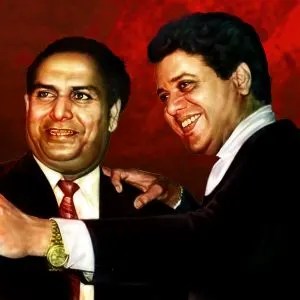
Shankar Singh Raghuvanshi (15th October 1922 to 26th Apr 1987)
Jaikishan Dayabhai Panchal (4th Nov 1929 to 12th Sep 1971)
Among the great legendary music directors who created immortal film songs during the golden era of Hindi film music ( HFM) , that is from late 40’s to early 70’s , there were two, who ruled at the top for almost two decades. It is very rare to see quality and quantity going hand-in-hand , but Shankar Singh Raghuvanshi & Jaikishan Dayabhai Panchal could exactly do that ! They created sheer magic with their tunes that had an eclectic mix of the classical , catchy rhythm patterns, unparalleled orchestration that appealed to the connoisseurs as well as the laity. If we look at the Hindi film music( HFM) journey from the 1930’s when songs started appearing , the early years were influenced by Hindustani classical music and Rabindra sangeet style of music. They were no doubt melodious but was not that much understood and appreciated by the masses. However , when Shankar -Jaikishan ( abbreviated SJ from now onwards) stormed the music scene with the film Barsaat in 1949, there was sudden whiff of freshness in the music that was melodious and at the same time with a faster tempo and an easier format for a layman to appreciate and sing along. From then it was literally a “ barsaat” of hit songs for the next two decades, uninterruptedly.
The impact of their music was so powerful that even in regions within our country where Hindi is not the main language, their songs Like Awaara Hoon or Ramayya Vastavayya became so popular. Crossing the seas, even in far off countries where the Hindi language was unknown, like Turkey, Russia & China people could sing along with “ Awaara Hoon” ! Talking about that song , noted music director Pyarelal of the Laxmikant -Pyarelal duo once said , if one has to understand S-J , it was that accordion piece that comes immediately after that Awaara hoon line. We cannot think of that song without that piece. That , in essence , was S-J style. For their fans , every note of the preludes and interludes of the songs are almost etched in memory.
The pulse of the masses was rightly discovered by S-J . Their compositions were a heady cocktail of underlying classical raag base to which they added a fast , catchy rhythm, an orchestration with superb preludes, interludes & postludes, even to the extent of composing sad songs with a faster tempo -all these factors making them the undisputed ‘emperors ‘ of HFM till around 1970. If I can go a little overboard , I can even call them the ‘ superstars’ among music directors. They painted with a larger canvas and made songs the center-piece of a film , and started getting paid sometimes even more than the main actors ! Their names in the posters were enough to pull the crowd. With 179 films and around 1300 songs , any discussion on the golden era of HFM cannot be complete without their music. In one of his shows, noted lyricist and story, screenplay writer Javed Akhtar rightly described their music as: “till the advent of S-J , film song was a short story, but S-J made it into a novel” There can be no better way to describe .
Somehow, despite all the greatness in their career, today we seem to have totally forgotten them, more so in the so-called mainstream media, radio/TV channels that keep harping about just one or two names always! The year 2022 was the birth centenary of Shankar, and sadly there was no mention of that! That is no surprise as the film world is notorious for ignoring many such stalwarts . For Shankar , the neglect started immediately after the sad and sudden demise of his partner Jaikishan in 1971. Even more irritating is that in many of the books or blogs , whenever they talk about S-J , they start off with how the glorious music they gave initially deteriorated in their later years ( as if all other music directors did not have their creativity reducing in later years!) , their so-called rift , and again how they did not deserve some of the Filmfare awards etc. Somehow I find this repulsive and so would not talk anything about that and would, instead dedicate a two-part blog to capture their excellent music. S-J’s music has to be celebrated.
I started writing this blog on 16th October ’24 just a day after the 102nd birth anniversary of Shankar. By the time I complete this blog it would be closer to 4th November which happens to be the 95th birth anniversary Jaikishan. This blog comes immediately after my earlier one on the genius Sajjad Husain. I am wonder-struck with the contrasting variety that we had in the music of the golden era. Sajjad music became immortal with just less than hundred songs and on the other extreme end of the spectrum we have S-J with more than 1300 songs , working with some 115 different movie banners and around 100 different film directors!
One may wonder why I am going overboard in praising their music. In any creative art, sustaining the top position for two decades is definitely a great achievement , more so in the intensely competitive film industry. Also there may not be a single day when their songs are not played or remembered . Their songs were the first to transcend our borders and go to various regions like Russia , the middle-east and even Europe. One of their songs Jaan Pehchaan Ho ( from the film Gumnaan, sung by Mohammad Rafi) is strangely ignored in our country , but so many artists in Europe & USA have recreated that and even used it in a commercial advertisement for a beer brand and in the titles of a Hollywood movie Ghost World! Songs like Awaara Hoon , Mera Joota Hai Japani, Kisiki Muskurahaton Pe Ho Nisar , Aaj Kal Tere Mere Pyaar Ke Charche, Yahoo!..Chahe Mujhe Koi Junglee Kahe, Zindagi Ek Safar Hai Suhana are popular even in those regions of our country where people may not know Hindi.
At their peak , they mostly used a grand 60–70-piece orchestra ! They were the highest paid among music directors, reaching an astronomical figure of Rs 5 lakhs in the 60’s. It is a fact that many actors owed their career to the super hit songs scored by S-J in their films. They had the maximum number of silver jubilee and golden jubilee films in those days. It is said that , if the film producer was able to rope in S-J , a simple letter from the duo that they are composing music for the film , would make financiers queue up for funding the film. Sometimes the film posters used to have only “ Music by Shankar Jaikishan” rather than the name of actors and it was a guarantee for success. Only one other music director had this recognition and that was O.P Nayyar.
How these two legends joined together is interesting. They were from different backgrounds. Shankar, a Punjabi born in Madhya Pradesh and brought up in Hyderabad ( then in Andhra Pradesh & now in Telengana ) and Jaikishan , a Gujarati , born in Bansada, Gujarat. Both did not have much of formal education. But music was their passion. When these two met at the office of Gujarati film director , Chandravadan Bhatt in search of opportunities to score music for films , they discovered their common interest and that is how their association began.
Shankar started working for the Prithvi theatres that was run by Prithviraj Kapoor and he introduced Jaikishan as a harmonium player. Shankar had by then learnt to play Harmonium , Tabla, Accordion, Piano and also learnt kathak dance. When Prithviraj ‘s son Raj Kapoor made his first film , Aag in 1948 , he chose Ram Ganguly as the music director. S-J assisted him on the orchestration and Shankar was also assisting the noted music duo Husanlal -Bhagatram . When Raj Kapoor wanted to make Barsaat in 1949, he had some issues with Ram Ganguly and that is how luck smiled upon the young S-J to fetch them their first break as independent composers. Barsaat’s music brought in a huge wave in the form and style of HFM that catapulted them to the top. Initially , it is said that many other veteran music directors were initially skeptical and only C Ramachandra had remarked that one day these boys will prove to be tough competitors!
Although they composed under the joint name Shankar-Jaikishan, it is no secret that they used to compose the songs individually. However they had their trusted arranger for orchestration and percussion in common: Sebastian D’ Souza taking care of the orchestration and Dattaram Wadkar, looking after the rhythm section. It is said that Shankar’s forte was more on dance-based songs, theme-based songs and in Raj Kapoor’s films the title song was always Shankar’s responsibility. He worked more with Shailendra. Jaikishan was more into the romantic and sad songs and worked with Hasrat Jaipuri. Jaikishan was also an expert in background music. He was also more social and looked after the financial aspects. He had the skill to interact with the outside world whereas Shankar was more of an introvert , a bit short tempered , traits that would go against him after the demise of Jaikishan. He was not the party-going type unlike Jaikishan and was happy with his other hobby, that was wrestling! Many stories were written about their so-called rift post Sangam film. I read somewhere that Shankar himself denied those stories.
More than two years back , in this blogsite I had written about the golden team of S-J with their inseparable lyricists Shailendra & Hasrat Jaipuri. During those days , I was not embedding the songs and so it was just a long write up on some of their best songs. Their music is an ocean and I am sure that I would be able to pick many other songs that I could not cover in my earlier blog .
To my pleasant surprise, when I started listing out their songs , I found that I could pick an astonishing 50 songs from their debut year 1949 to 1960! And there was more to come from the decade of 60’s which was their peak! So I am breaking this blog into two parts-Part 1 covers 1949 to 1960 and Part 2 the years after 1960 till Shankar’s demise in 1987. Many music critics tend to completely dismiss the songs composed by Shankar alone , but I beg to differ and found many good songs composed by him in the 70’s. I will try to cover them in Part 2.
Songs are sequenced chronologically, as per the year of their films, with song /film/year/singer(s) and lyricist mentioned in that order.
- Patli Kamar Hai Tirchhi Nazar Hai/Barsaat/1949/Mukesh & Lata / Shailendra
I have selected this song as this shows the early signs of S-J’s fabulous orchestration. Note how they seamlessly switch over from the foot-tapping part that Mukesh sings in contrast to the sober Lata’s part. The long association of Mukesh & Lata would continue for many years with S-J . With Barsaat , S-J had arrived in a grand style!
2. Tere Bina Aag Ye Chandini-Ghar Aaya Mera Pardesi/Awaara/1951/Manna Dey & Lata/Shailendra
Can someone believe this song was composed around 75 years back! A classic example of their grand orchestration. Starting off slowly with Lata’s slow lament conveying the pangs of separation , the song jumps to a fast tempo with Manna Dey conveying the frustration of on screen Raj Kapoor soulfully. The violin arrangement became a trademark of S-J and stayed with them in most of their songs. Mandolin brings in the joy when Lata starts off with the lines ‘Ghar aaya mera pardesi’ with that famous dholak beats of Dattaram who was instrumental in providing a great percussion support in all S-J songs. That peculiar style of Dattaram’s dholak had a unique term in the industry-Dattu’s theka!
3. Aawara Hoon/Aawara/1951/Mukesh/Shailendra
This song could be termed as the most famous song from India, having captured the hearts of Russia , Turkey, and many other Middle-Eastern countries. It was mentioned even in the Noble -prize winner Aleksandr Solzhenitsyn’s novel Cancer Ward! A simple tune , but the way in which S-J composed it with the follow-through accordion, and those fabulous interludes, and last but not least , Shailendra’s simple but heart-touching poetry make this song an eternal one.
4. Ae Mere Dil Kahin Aur Chal/Daag/1952/Talat Mehmood/Shailendra
One of the earliest examples of counter -melody. Note how S-J play with accordion in the antara. A simple song , but remains popular till today, with Shailendra’s poetry that touches every heart. Although Talat Mehmood sang very few songs in S-J’s direction, this one will count among his top ten without a doubt.
5. Jhoome Jhoome Dil Mera /Poonam/1952/Lata/Hasrat Jaipuri
In the 50’s Lata’s career was to a great extent shaped by S-J’s solos, a fact that she might not have attached much importance , but we , fans of Lata & S-J can very well appreciate. In this article alone there are around 11 duets and 6 solo songs of Lata-all fantastic ones. The best part in this song is the manner in which the interlude starts with that fabulous accordion playing just for few seconds only to handover the baton to those violins . All along the mandolin gives great company to Lata , with a flute that chirps like a bird in between. Tere is never a dull moment in S-J’s orchestration. They embellish each and every part of the song.
6. Aa Neele Gagan Tale/Badshah/1953/Hemant Kumar & Lata/Hasrat Jaipuri If I can rank the famous duets of Hemant Kumar & Lata , this song will definitely be in the top 10!. What a haunting superb melody , accompanied by an under-stated orchestration that has accordion , harmonium , violins with a waltz rhythm.
7. Manmohana Bade Jhoote/Seema/1955/Lata/Shailendra
For all those critics of S-J who trivialized their music as ‘copied from western music’ or ‘too loud’ , they gave a fitting reply by composing songs like Manmohana Bade Jhoote and also with all the songs of Basant Bahar. Based on raag Jaijaivanti, with that exceptional singing by Lata, S-J prove that they do not need a 60–70-piece orchestra always! They have used just a tanpoora, tabla & sarangi in this song.
8. Ramaiyya Vastavayya/Shree 420/1955/Rafi, Mukesh & Lata/Shailendra
An iconic song that is popular across our country, even in non-Hindi speaking regions! One of the best songs with three legends singing together: Rafi , Mukesh & Lata. Shankar , having been brought up in Hyderabad knew Telugu and it is said that once he, along with Jaikishan & lyricist Shailendra were waiting for tea in a small tea stall where the boy serving tea was supposedly named Ramaiyya. Shankar was calling out to him for bringing the tea -the first lines of this song in Telugu translates to” would you come , Ramaiyya” . Jaikishan started putting those words to a tune and Shailendra filled in the rest of the lines. A legendary song was born!
9. Duniya Na Bhaye Mohe/Basant Bahaar/1956/Rafi/Shailendra
As I had mentioned earlier , with the film Basant Bahar , S-J figuratively slapped their critics and proved they can compose songs with pure classical base as much as a jazz or rock& roll song. One can include all the songs from this film , but due to brevity , I am including this one and another gem of a song by Manna Dey.
10. Bhaya Bhanjana Vandana Sun/ Basant Bahaar/1956/Manna Dey /Shailendra
The music directors of the golden era were firm in deciding who should sing which song. It seems the producer & director wanted Rafi to sing all the songs of Basant Bahaar , but Shanker was very firm in insisting Manna Dey for this and few other songs in the film. What a great decision and how soulfully Manna Da has rendered this song based on Mian Malhaar raag. I literally have goosebumps whenever I listen to this song. I have read articles and seen videos , where many ignore the name of Shankar in giving a major boost to Manna Da’s career. But the man who really matters, Manna Dey always acknowledged the contribution of Shankar to his career and that is enough.
11. Yeh Raat Bheegi Bheegi/Chori Chori/1956/Manna Dey & Lata/ Shailendra
Should I write anything about this classic romantic song that flows through like a meandering river. Set on a base of raag Kirwani , the guitar, string arrangement with that solo violin and sarangi all playing on your ears till you are elevated to a tranquil state. Once again , it was Shankar who firmly put his foot down and rooted for Manna Dey and also gave a completely new genre to him, namely romantic songs. Manna Da , till then was mostly associated with only classical, philosophical, and sad songs. The producer was from south, the renowned A.V Meyappa Chettiar insisted on Mukesh as an obvious choice since the hero was Raj Kapoor. Shankar convinced him to listen to Manna Da and then decide! After listening , AVM , luckily agreed! All the three duets in this film were sung by Manna da. Chori Chori also fetched S-J their first Filmfare awar
12. Dil Ka Na Karna Aitbaar Koi/Halaku/1956/Rafi & Lata/Shailendra
Many a times it so happens that though the film faded away from memory , its music was not at all forgotten. I am sure that if you ask the die-hard fans of S-J , they would definitely mention this film , remembered mainly for the songs. Halaku, for me , is one among S-J ‘s superb albums. I have included three best songs from this movie-all are truly masterpieces for the excellent orchestration and catchy tunes. That famous Dholak of Dattaram , and oh God that Mandolin !! No words can do justice in describing these songs. Just listen to these 3 gems and get yourself immersed in their melody.
13. Aaja Ke Intezar Mein/ Halaku/1956/Rafi & Lata/Shailendra
The waltz like rhythm, Rafi & Lata ‘s great singing , the strings and cellos that come in waves and that mandolin making its presence felt in between only to fade away at the blink of the eye! Sheer magic…
14. Yeh Chand Yeh Sitare / Halaku/1956/ Lata/Shailendra
It appears that a most of us have forgotten this gem. I have very rarely heard this played even in the good old Vividh Bharati. Just observe that percussion arrangement, the interlude with guitar and mandolin pieces throughout the song.
15. Aaye Bahar Banke Lubhakar/Rajhath/1956/Rafi/Hasrat Jaipuri
With Rafi, S-J could give peppy Yahoo style songs and at the same time come out with such soulful melodies also. Here he has literally poured out his heart into the song. Rafi’s singing directly touches your heart and that is why they remain evergreen. Knowing this , S-J kept the orchestration to the bare minimum and let the master take over!
16. Bol Ri Katputli Dori/Katputli/1958/Lata/Shailendra
During the 50’s , S-J had composed so many songs like this one for Lata that brought out the best in her. Once again , a lesser-talked about and recognized fact is that S-J were instrumental in taking Lata to the heights of her popularity. Sadly , she herself had not acknowledged this much except in one or two occasions. Apart from being a masterpiece to listen to , this song is a visual treat. Vyjantimala did not require any elaborate costume or setting. In the simplest of the setting and dress, she pulls off a scintillating dance and emotes the song on screen to perfection . Truly great !
17. Aate Jaate Pehloon Mein aaya koi/Yahudi/1958/Lata/Shailendra
Continuing on the same lines from the earlier song, one more rare solo of Lata in S-J’s composition that has a superb dholak.
18. Yeh Mera Deewanapan Hai/Yahudi/1958/Mukesh/Shailendra
Somehow S-J could always bring out the best in Mukesh. With very simple orchestration, S-J proved in this song they could create the same magic with Mukesh , not singing for Raj Kapoor in a R.K Film banner , but for Dilip Kumar in Bimal Roy’s film!.
19. Tera Jaana Dil Ke Armanon/Anari/1959/Lata/Shailendra
That interlude alone deserves all the awards in the music industry!! What a magnificent prelude and interludes. Piano & string arrangement in this song are simply out of the world. Not to forget one of Lata’s most soulful rendering. Most of S-J ‘s songs have three antara , but this one just has two but that is enough to prove their innovative variations.
- 20. Yaad Aayee Aadhi Raat Ko/Kanhaiyya/1959/Mukesh/Shailendra
One lesser-heard gem from Mukesh-SJ -Shailendra combination with a slow pace and that typical low octaves in which Mukesh was absolutely sweet. Note the conversation that the violins have with Mukesh every time he asks “ kist baat ki tauba”. I could have also included the other song “ Mujhe Kuch Bhi Na Chahiya “ which is more popular…with S-J it is always a difficult choice .
- 21. Dheere Dheere Chal Chand Gagan Mein/Love Marriage/1959/Rafi & Lata/Hasrat Jaipuri
Only the words say “ Dheere Dheere chal” ; S-J’s tune, zooms like a formula 1 race! One can sense the pace right at the beginning with those violins and guitars playing at a frenzied pace. Most of the S-J fans can identify the song just by listening to few seconds of the prelude! And when you have two greatest romantic voices behind the microphone , what else do you need?
- 22. Kahe Jhoom Jhoom Raat / Love Marriage/1959/Rafi & Lata/Shailendra
If anyone accuses me for being too much biased towards Lata & Rafi, it is OK. I accept with all humility! It is impossible for me to ignore these immortal numbers! It is a well-known fact that many music directors used to say that when they have Rafi & Lata , they do not have any restrictions in composing the tune at any pitch or any scale or range or tempo. S-J utilized their skills to the full. The uniqueness of S-J ‘s interludes , ably assisted by Sebastian and Dattaram is that they become a painter who steps back , looks at the painting and keeps adding few strokes of the brush repeatedly till the painting becomes masterpiece. Almost all the interludes of S-J are like exquisite paintings!
- 23. Duniya Walon Se Door/Ujala/1959/Mukesh & Lata/ Shailendra
While researching for this blog I was surprised to note that during the early 60’s a whole lot of Hindi film songs were recreated in far-away Greece by many singers. This was absolutely new information for me. I only knew about Awaaara Hoon being recreated in Turkey . There is a nice Greek version of this song Duniyawalon Se Door . The prelude with those bongos beat and that combination of mandolin and xylophone ( I hope I am right in identifying the instruments) sets the mood of the song. The mood they create is as if the lovers, true to the words, duniyawalon se door jalnewalon se door aaja aaja chale kahin door, are running away. S-J can create sheer magic with their tunes that conveys the entire emotion of the song. That is why they were the emperors!
- 24. Ajeeb Daastan Hai Yeh/Dil Apna Aur Preet Parayee/1960/Lata/Shailendra
One more song that was recreated by a pop group called Ivy York in 2010, almost 60 years after Ajeeb Daastan Hai Yeh was composed. No doubt, S-J ‘s composition was inspired from Jim Reeve’s song “My lips are sealed” , but if one can keenly observe they had just taken the first line only. The preludes, interludes were superbly embellished by them and that is why I hate when critics of S-J keep harping about their so-called plagiarism. Many-a-times they had made it even more beautiful than the original one. For that matter most of the legendary music directors had, on few occasions , had taken inspiration from others , but that stamp was always made on S-J!!
- 25. Aa Ab Laut Chalen/Jis Desh Mein Ganga Behti Hai/1960/Mukesh & Lata/ Shailendra
A song of epic proportions! It is said totally there were more than 70-80 artists ( violin , cello, guitar, percussion etc and a huge number of chorus singers ) apart from the main singers Mukesh and Lata. The entire orchestra couldn’t be accommodated within the recording studio and some had to even spill over to the corridors. In order to avoid disturbing noise from outside , they recorded this at the dead of night so that there was no traffic noise! We can only imagine what S-J would have done if they had today’s modern technology. The alaap of Lata at the end and the climax of the song is something that gives one goosebumps.
With these 25 songs, I complete the Part1 of my blog. Hope I have been able to pay my tribute to these great composers , whose music will never fade away in hundreds of years to come. I will come up with its sequel soon. Maybe I need part3 also , if the list becomes too long! With S-J one can never have enough!
Acknowledgement & Disclaimer
I sincerely thank the publishers of following Internet sources for the information that I could gather for this article:
- You Tube
- Wikipedia
Acknowledgements and Disclaimer:
The songs mentioned are from the popular, public domain and have been mentioned and embedded here only for the listening pleasure of the music lovers. This blog does not claim any copyright over them, which rests with the respective owners of the rights.
 Music Unrestricted